Robot Dog. Home Dog. (It's coming.)
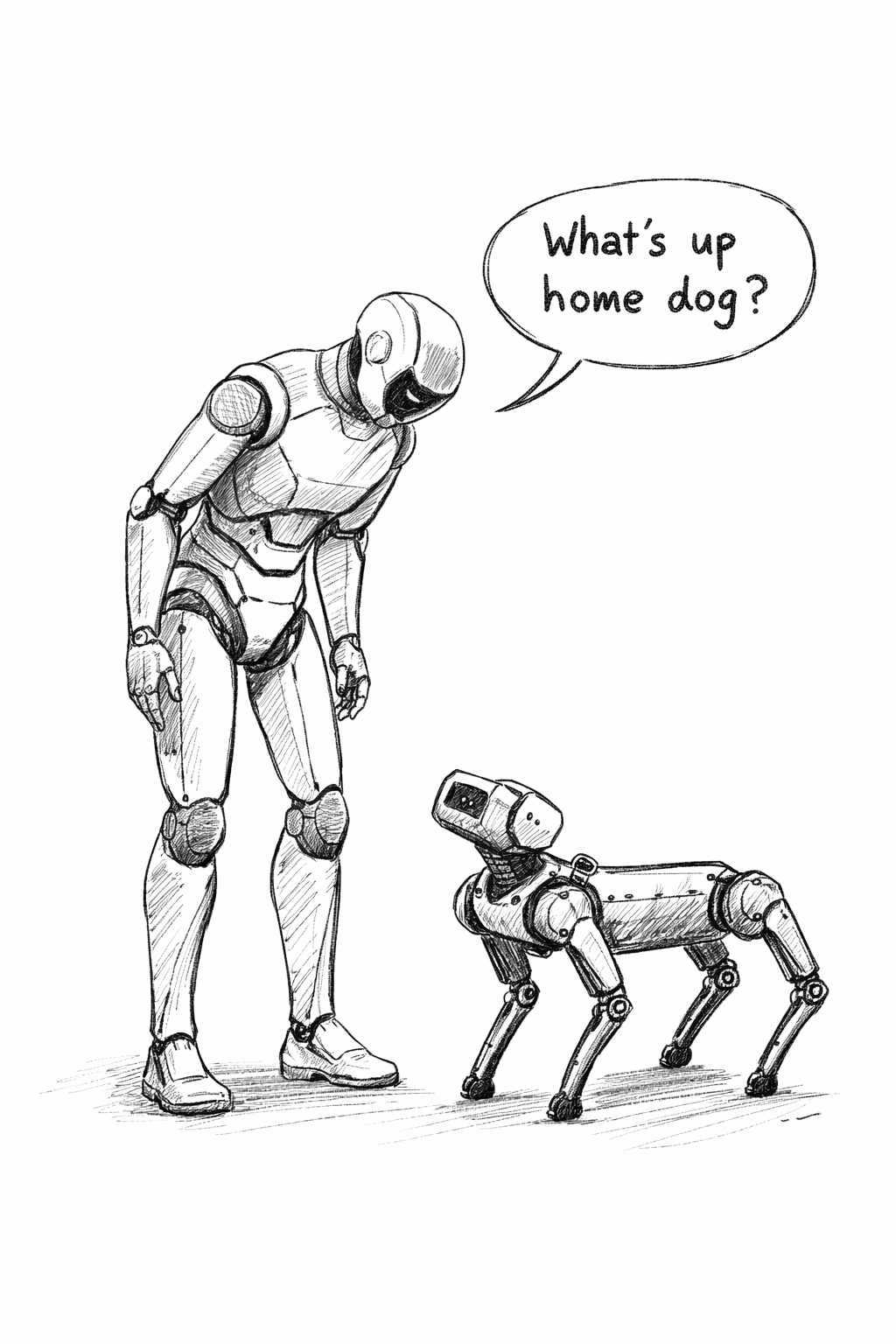
When Tony Yang from Unitree Robotics first said “home dog,” I smiled inside. I was a teenager in the 80s; I can’t not react to that phrase.
But he wasn’t joking. He was talking about an actual product: a robotic dog for the home, coming this year.
As my enthusiasm in the video shows, this is a concept I care deeply about. I’ve spent a lot of time thinking about what quadrupeds could do in caregiving and how they might actually fit into real homes.
The story of Helen
There’s a woman at my local YMCA I can only describe as a spitfire. We’ll call her Helen. She’s 95 and still comes to the center for exercise classes. She has an opinion about everything, and there’s a real charm to her outspokenness.
“I like your hair,” she abruptly told me one day, starting a conversation.
“Uh… thank you,” I replied, thinking I had gym hair but willing to take the compliment. I was then interrogated for fifteen minutes about my occupation, marital status, and where I grew up.
About a month later, she walked in with a copy of TIME. “You said you work in robotics. This robot. Tell me about it.”
I explained what a Figure robot is and why it was on the cover.
“Could it help me?” she demanded.
I paused. It was a good question.
“Would you rather have a robot in the house than a human caregiver?” I asked.
Helen didn’t hesitate. “Yes.”
And I get it. A robot is a machine; a human caregiver is an invitation into your private life. For someone Helen’s age, a robot is closer to an appliance—or maybe Rosie the Robot from The Jetsons. It just makes sense.
But is it realistic?
Why humanoids won’t solve this
Humanoids get most of the love from the press and VCs. Dancing humanoids. Vacuuming humanoids. Humanoids doing parkour and playing soccer.
None of that says: “Ready to move in with 95‑year‑old Helen.”
Humanoid robots are not ready for a private home, and they won’t be for a while. Five to ten years is probably the minimum before they’re genuinely safe, reliable, and affordable for everyday people.
If you’re 57, like me, you can wait for that curve. You have decades before you truly need a helper in the home.
Unless Helen is a superager, she can’t wait for all that innovation. She needs a solution now.
The overlooked form factor
Quadruped robots have been getting overlooked in the humanoid hype cycle. They’re commonly called “robot dogs,” and the name has stuck. These aren’t Sony Aibos. They’re working quadrupeds built for real environments.
They already move well in messy, physical spaces. They’re stable, grounded, and built for terrain that trips up bipedal designs. Just as important, they’re familiar.
Even without Aibo’s cartoonish face, the basic shape already connotes “dog.” Place the sensors so they read as “eyes,” put a horizontal camera roughly where the “mouth” would be, and you’re done. You have a home dog.
A dog‑shaped presence in a home doesn’t feel like an intrusion. It feels like a natural extension of something people already know.
At the same time, Unitree has this terrifyingly tall humanoid, the H2. It’s… a lot. You can see it on people’s faces as they walk by. They’re unsure.
The robot dogs? Smiles.
A home dog can fill the gaps where seniors might need a non‑obtrusive monitor. A guardian. That’s a role dogs have always played in our lives.
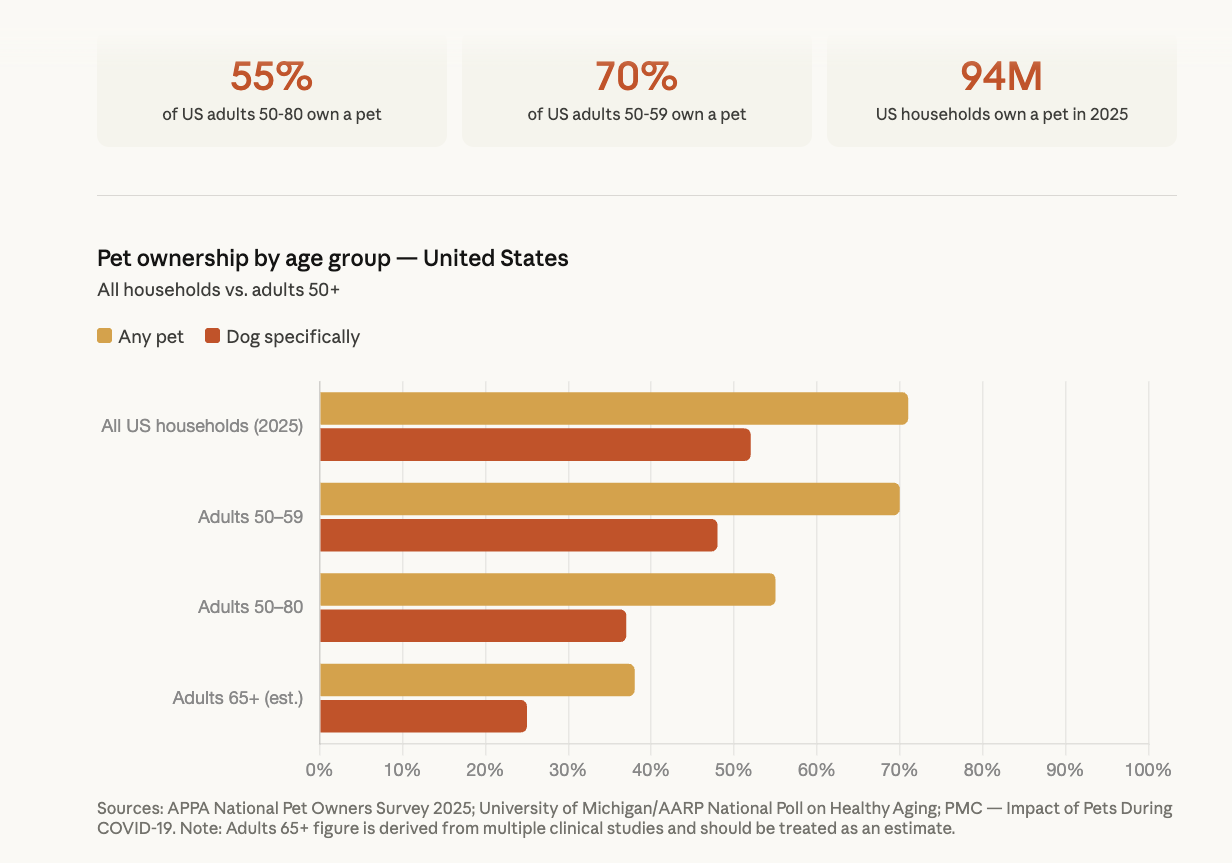
Since I’m usually on the receiving end of Helen’s questions, I haven’t been able to ask if she has a dog. But odds are, there’s some sort of pet in her home. Statistically, that’s a safe bet.
What the gaps actually are
Falls are the leading cause of injury for adults 65 and older, and more than one in four older adults falls each year. Many never tell their doctors because they fear losing independence or being forced into assisted living. The CDC notes that millions of these falls result in emergency department visits or hospitalizations every year, and a significant share lead to injuries that restrict daily activity or require medical treatment.
What most families actually experience is this: one incident, one missed warning sign, and suddenly the conversation about independent living is over.
A home dog that can notice a fall, unusual inactivity, a stove left on, or a door left unlocked—24 hours a day—changes that equation. It doesn’t replace human care. It extends the window. For a senior who wants to stay in their own home, that extra dignity is everything.
There’s also the cost reality. Part‑time or full‑time human caregiving is ongoing and expensive in a way that compounds over years. A one‑time hardware purchase, even a significant one, is a fundamentally different financial equation for most families. As more robotics companies enter this space, prices will drop. I can see a future where home dogs that monitor are as common as Roombas, sitting on the shelf at Costco.
“Honey! I’m going to Costco. I need a new robot!”
“Get a good one!” I was tempted to add: “Make sure it speaks Bocce.”
The concerns you shouldn’t ignore
Privacy is the obvious concern. A device with cameras and sensors inside a private home is going to raise hard questions, and those questions deserve straight answers.
With Unitree specifically, those questions are not hypothetical. In September 2025, two separate security disclosures emerged that every potential buyer should know about.
The first was the UniPwn exploit, disclosed around September 20, 2025 by security researchers including Andreas Makris and Kevin Finisterre. They documented a critical flaw in the Bluetooth Low Energy Wi‑Fi configuration used by Unitree’s Go2 and B2 quadrupeds and G1 and H1 humanoids. The issue allowed attackers to gain root‑level access wirelessly and, because it was “wormable,” an infected robot could automatically compromise other Unitree robots within range. The researchers also highlighted a history of difficult communication with Unitree when disclosing vulnerabilities.
The second disclosure came from Alias Robotics. Their analysis of the Unitree G1 found that it continuously transmitted data to servers in China every five minutes, without user knowledge or meaningful consent mechanisms in the interface. The data included status and sensor information and maintained connections that automatically re‑established if interrupted. Alias later reviewed Unitree’s firmware and app updates and concluded that while minor fixes were introduced, critical vulnerabilities remained and periodic telemetry to servers in China continued.
In Europe, researchers argued this behavior runs afoul of GDPR. In the United States, it appears to conflict with California privacy law around undisclosed data collection.
Unitree released public statements acknowledging the issues and committing to fixes. But the broader lesson is clear: if you are putting one of these systems into the home of a vulnerable family member, you need to have a serious conversation about security and data. Trust will matter as much as capability. Probably more.
I’m not saying Unitree is disqualified as a player in the home dog space. I am saying you should go in with eyes open. My future home dog will probably be made in the United States. But, I’m glad Unitree is kicking off the market. We need a product like this one.
Where the market goes from here
If Unitree releases a home dog, they won’t be alone for long. Other companies will follow. Some will compete on price. Others will compete on trust. Manufacturers outside China may never match a Chinese company’s price point, but they’ll have a different story to tell on data sovereignty and regulatory alignment.
According to one recent forecast, the global quadruped robot market was valued at about 240 million dollars in 2025 and is projected to reach roughly 759 million dollars by 2034, a compound annual growth rate of 19.4 percent. The consumer home segment of that market is still largely untapped.
The Roomba didn’t arrive at Costco on day one either. It took time, competition, price compression, and consumer familiarity before robotic vacuums became an unremarkable household purchase. The home dog is on a similar curve—not tomorrow, but no longer a thought experiment.
The Era of “Home Dog”
“Rosie” from the Jetsons didn’t look like us. She had wheels. She looked like a machine and she was likely the home robot that set the standard for Helen’s generation.
The real test isn’t resemblance. It’s about helping someone, like Helen, stay in their home longer. The first robot to gain real mass adoption, beyond the Roomba, will likely not be humanoid at all.
We just may be entering the era of the home dog. We already look at our dogs as both guardians and companions. Same idea, just this one has a few more features, and needs to charge at night.
(And, needs to have the security concerns ironed out.)
Tony Yang says it’s coming this year.